
 ServiceM8
 Calculations
 Fergus
 AroFlo
 OpenSolar
 Enrol in Sequence
 Address Finder
 Pylon
PylonHow a Complex HubSpot Setup Became One Clean Pipeline

Client
Solar Energy Company (NDA client)
Year
2026
Services
Integration
Industry
Solar
COMPANY
INDUSTRY
LOCATION
Challenge
Solution
SERVICES DELIVERED
Tech Stack
0
duplicate leads reaching the sales team
A lead's status might live in a field called "Lead Status," a second called "Status," and a third called "Lead_Status_Internal," each updated by a different person for a different purpose. A report pulled from one field told a different story to a report pulled from another.
Every month over the contact tier limit meant an avoidable billing penalty, and no one had built the workflows needed to keep the list clean on an ongoing basis.
Salesforce was the client's system of record for sales, installer partnerships, and hardware serial numbers. The existing HubSpot integration was meant to hand off qualified leads cleanly, but instead pushed duplicate and low-quality records into Salesforce, cluttering the sales team's view of who was actually a real prospect.
The marketing team knew HubSpot was underperforming but didn't have the in-house specialism to diagnose a data structure this tangled, and needed a partner who could act as their marketing operations function rather than an outside consultant parachuting in for a single project.
The Solution: How did T&H Digital properly configure the HubSpot and Salesforce integrations?
-
Same data point tracked in 3-4 conflicting properties
-
Marketing contact list managed manually, often over tier
-
HubSpot to Salesforce sync created duplicate leads
-
30-50 overlapping, conflicting workflows
-
No internal HubSpot specialism
-
One property per data point, enforced by workflow
-
Criteria-based workflows keep the account within tier automatically
-
Bi-directional sync with clean lead source, lifecycle stage, and deal status
-
Consolidated into a smaller, higher-efficiency set
-
T&H Digital embedded as ongoing marketing operations partner
Before
After

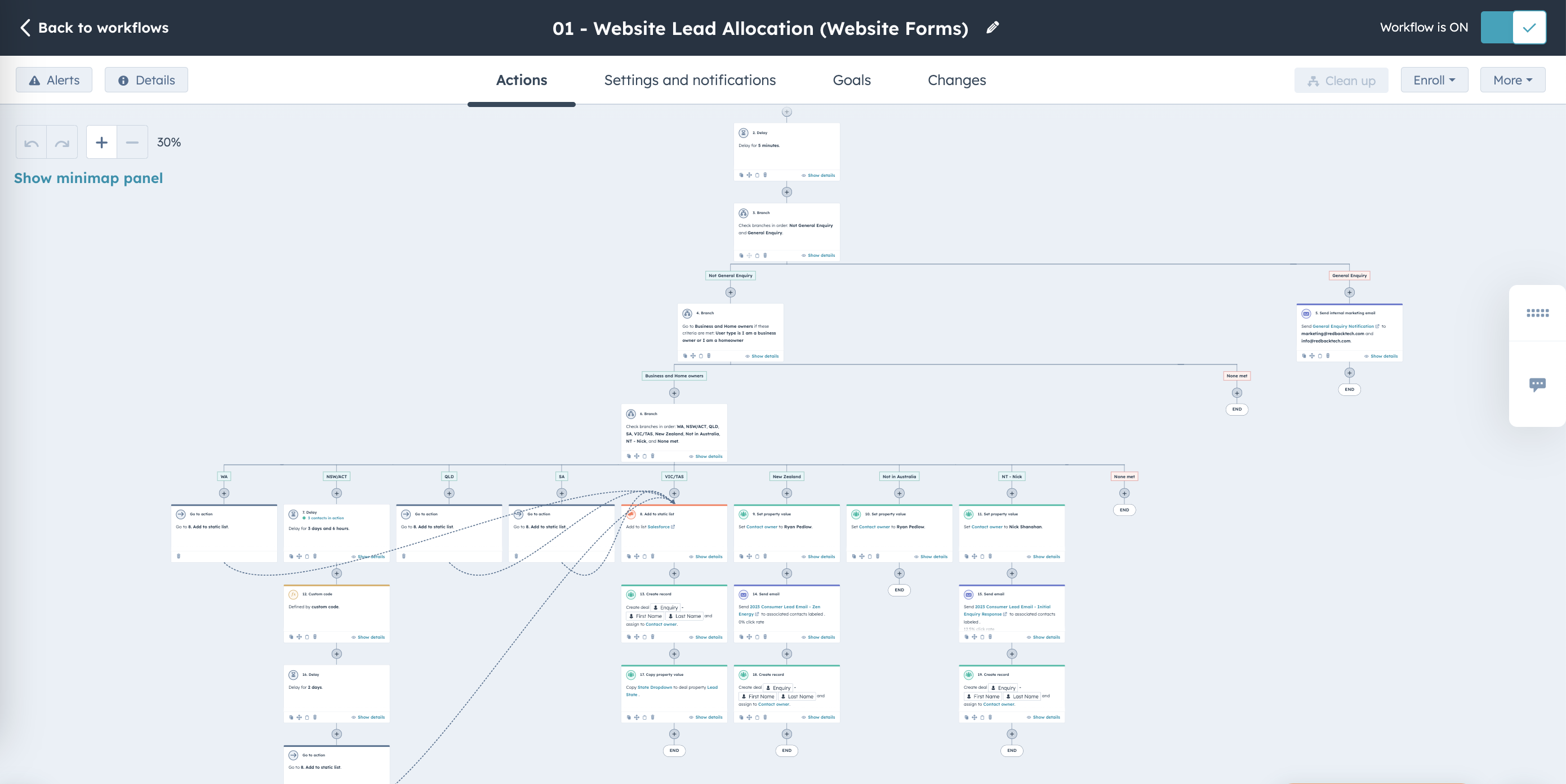
Marketing can see which campaigns lead to an actual hardware installation, not just a form fill, because lifecycle stage and deal status now flow automatically between systems.
Criteria-based workflows keep the account within tier automatically
The account stays within its HubSpot contact tier without anyone manually pruning the list each month.
A tangle of overlapping workflows is now a smaller set the team can actually reason about and maintain.
Who this solution works for
This kind of engagement fits businesses that already have HubSpot and Salesforce running, but don't have the in-house skills to keep the data clean or the integration reliable.
Good Fit
Manufacturers or hardware businesses selling through both direct and partner/installer channels
Teams where Salesforce and HubSpot are both live but not talking to each other properly
Businesses regularly billed for HubSpot contact tier overages
Marketing teams without a dedicated HubSpot specialist on staff
Needs something else first
Businesses not yet using Salesforce or HubSpot at all — better suited to a build from scratch
Teams without a Salesforce admin who can approve changes on their side
Accounts small enough that a full integration isn't yet worth the investment
Start with a full audit of properties, workflows, lists, and reports before changing anything, so you're fixing the actual cause of the mess rather than the symptoms. From there, consolidate duplicate properties into a single source of truth and rebuild workflows to stop the problem recurring.
A proper audit reviews every active property, workflow, list, and report across contacts, deals, and companies, and checks how the account is actually being used against how it's meant to be used. It should surface duplicate or conflicting fields, redundant workflows, and anywhere the contact tier is being pushed over its limit.
A typical clean-up runs around two months for the initial audit and rebuild, followed by an ongoing retainer to keep the account optimised. The exact timeline depends on how many properties, workflows, and integrations need to be untangled.
Yes. Most engagements start with an existing, already-live HubSpot account rather than a blank slate. We audit what's there first and build the fix around the account's real history and data, rather than starting over.
It depends on how much of the underlying data needs cleaning up first. A straightforward bi-directional sync can be built in a matter of weeks, but if the HubSpot side has duplicate or conflicting properties, that clean-up work usually needs to happen before the integration is worth building.
Most commonly: contact details, lead source, lifecycle stage, and deal or customer status, in both directions. HubSpot pushes new leads and marketing engagement to Salesforce, and Salesforce pushes back deal outcomes like a deal moving from Lead to Closed Won, so both systems reflect the same customer journey.
Is your HubSpot account quietly costing you in overage fees and bad data?
- HubSpot Platinum Solutions Partner
- Custom Integration Accredited
- 2023 HubSpot Impact Award - Custom Integration