
 ServiceM8
 Calculations
 Fergus
 AroFlo
 OpenSolar
 Enrol in Sequence
 Address Finder
 Pylon
PylonWhy your HubSpot isn't working for your trade business
If HubSpot feels disconnected from how your trade business actually runs, the problem usually isn't HubSpot. It's that HubSpot was set up to sit beside your field system (ServiceM8, Fergus or AroFlo) instead of connected to it. Jobs, quotes and customer records end up duplicated across two systems that don't talk, which is exactly the gap Tradiate closes.
You bought HubSpot because it was meant to give you one view of your business. Every enquiry, every quote, every customer, in one place, with the follow-up handled automatically.
Instead you have a CRM that half your team ignores, reports that don't answer the questions you actually ask, and a sales process that still leaks jobs somewhere between the quote and the invoice.
Here's a number worth sitting with: research on spreadsheet and manual-entry errors puts the error rate in unreviewed manual processes at close to 88%. HubSpot doesn't fix that on its own. If your team is still manually copying a job from HubSpot into ServiceM8, Fergus or AroFlo (or the other way around), you've just moved the manual-entry problem into a more expensive piece of software.
Why does HubSpot feel disconnected from how you actually work?
Most trade businesses run two systems side by side. HubSpot handles the sales and marketing side, quotes, enquiries, follow-up sequences. A field service tool like ServiceM8, Fergus or AroFlo handles the operational side, scheduling, job completion, invoicing.
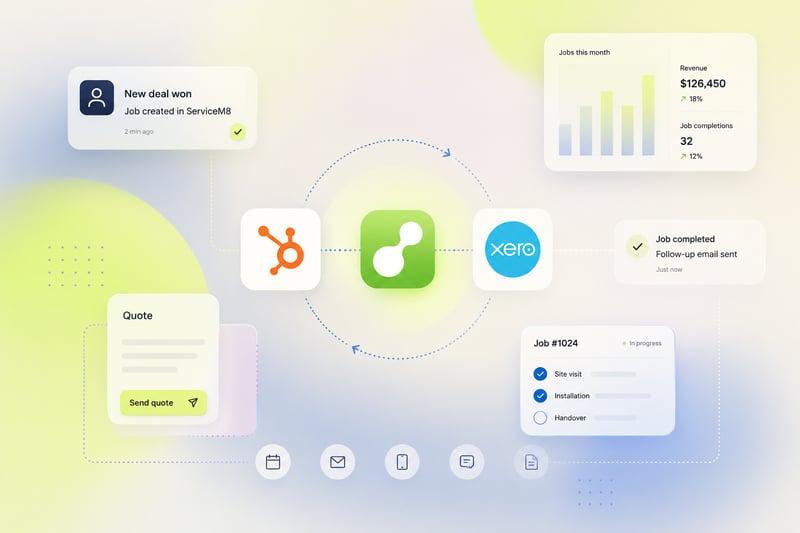
The problem isn't having two systems. It's that nothing connects them. A deal closes in HubSpot and someone has to manually create the job in the field tool. A job gets completed in the field and HubSpot has no idea, so the customer record goes stale and the next follow-up never happens.
That gap is where jobs get lost, invoices get delayed, and your team ends up doing the same data entry twice.
What is this actually costing you?
- Lost jobs: a deal sits in HubSpot for two extra days because nobody's told the field team it exists.
- Admin hours: someone on your team is spending real hours every week manually re-entering the same job details in a second system.
- Bad reporting: your pipeline in HubSpot doesn't reflect what's actually happening on the ground, so forecasting is a guess.
- Cold customers: a completed job in the field tool never updates the customer's HubSpot record, so the next follow-up or review request never goes out.
How do you actually connect HubSpot to your field system?
This is the specific problem we built Tradiate to solve. Tradiate connects HubSpot and ServiceM8 directly, so a deal won in HubSpot automatically creates the job in ServiceM8, and a job completed in the field automatically updates HubSpot. No exporting, no manual re-entry, no gap for a job to fall through.
For businesses running Fergus or AroFlo instead, we build the same connection as a custom integration, tailored to how each platform structures its data. These aren't yet productised the way Tradiate is (they haven't hit the install volume for a marketplace listing), but the underlying approach is the same: one system of record, not two half-updated ones.
Does this only matter for bigger trade businesses?
No. The businesses that feel this gap hardest are usually the ones growing fastest, because growth is exactly when manual workarounds stop scaling. A five-person team can survive someone manually re-keying three jobs a day. A twenty-person team can't.
If you're at the point where a job can sit in HubSpot without anyone in the field knowing about it for a day or more, that's the signal it's time to connect the two systems properly rather than add more manual process around them.
What should you do next?
Start by mapping where the handoff actually breaks today. Is it deal-to-job? Job-completion-to-CRM-update? Both? That single answer tells you exactly what needs to connect, and it's usually the fastest way to see the real cost of leaving it as is.
If you're running HubSpot alongside ServiceM8, Fergus or AroFlo and want to see what a properly connected setup looks like for your business, get in touch. It's what Tradiate was built to solve, and it's the work we do every day for trade, solar, construction and growth companies.
FAQs
Why doesn't HubSpot automatically sync with my field service tool?
HubSpot and field service platforms like ServiceM8 are built for different jobs, sales and marketing versus field operations, and they don't share data by default. A dedicated integration like Tradiate is what actually connects them.
How long does it take to connect HubSpot and ServiceM8?
It depends on how your data is currently structured, but most Tradiate setups are live within a couple of weeks once the mapping between the two systems is confirmed.
Do I need to replace HubSpot or ServiceM8 to fix this?
No. The fix is connecting the two systems you already use properly, not replacing either one. Setting HubSpot up correctly matters just as much as the integration itself.
What's the difference between Tradiate and a generic Zapier integration?
A generic automation tool can move basic fields between systems, but it isn't built for the specific way ServiceM8 structures jobs, and it breaks quietly when either platform updates. Tradiate is a purpose-built, maintained integration, not a workaround.
Do trade businesses need anything different from a standard HubSpot setup?
Yes. Trade businesses run jobs in field tools, so HubSpot needs to be configured to connect to those tools rather than sit beside them. Without that connection, the business ends up with the same split-data problem, just in two systems instead of one.
What if I use Fergus or AroFlo instead of ServiceM8?
We build the same kind of connection as a custom integration for Fergus and AroFlo. They aren't marketplace products yet, but the approach and the outcome are the same.


Comments