
 ServiceM8
 Calculations
 Fergus
 AroFlo
 OpenSolar
 Enrol in Sequence
 Address Finder
 Pylon
Pylon5 Signs Your Business Has Outgrown Spreadsheets (and Needs a CRM)
TLDR
Who it's for: growing businesses still running leads, jobs or customers out of spreadsheets.
The problem: spreadsheets stop scaling once more than one person depends on them, and leads, follow-ups and reporting start slipping.
What to do: watch for the five signs below; when two or three are true, it's time to move to a CRM.
The outcome: one shared source of truth, follow-up that doesn't depend on memory, and reporting you can trust.
When you started your business, spreadsheets were probably a lifesaver. Quick to set up, easy to manage, and flexible enough for everything from tracking leads and managing contacts to basic financial forecasting.
But as your business grows, that trusty spreadsheet can quietly turn from a convenience into a liability. Leads fall through the cracks. Two people edit the same file and overwrite each other. Reporting becomes an exhausting monthly chore. And nobody is quite sure which version is the current one.
You're not alone in feeling it. Salesforce research found that 91% of CRM data is incomplete, stale, or duplicated, and Validity's 2025 report found 37% of businesses lost revenue directly because of poor data quality. It's a problem serious enough that HubSpot builds dedicated data-quality tools into its platform to fight it. A spreadsheet gives you none of that.
These aren't just minor inconveniences. They're signals your business has matured beyond what spreadsheets can reliably handle, and that's good news. It means you're ready for something better. Here are the five clear signs, and what to do about them.
1. Leads are slipping through the cracks
This is usually the first sign, and the most expensive. A lead comes in, gets added to a row, and then nothing happens because nobody owns the follow-up and the spreadsheet doesn't remind anyone. By the time someone notices, the customer has already booked with whoever replied first.
A spreadsheet stores contacts. It doesn't chase them. There's no automatic reminder, no task assigned, no record of who spoke to whom or when. Follow-up depends entirely on someone remembering, and memory doesn't scale.
A CRM turns each lead into something with an owner, a next step and a due date. The follow-up happens because the system prompts it, not because someone happened to scroll far enough down the sheet.
2. Collaboration has become a version-control nightmare
When one person runs a spreadsheet, it works. When three people do, it breaks. Someone's working from a copy on their desktop, someone else overwrote the column you needed, and there's a file called 'leads_final_v3_USE THIS ONE' that nobody trusts.
Shared spreadsheets promise real-time collaboration and mostly deliver quiet data loss. Two people edit the same record, one change wins, and nobody notices the other is gone. As the team grows, the amount of time spent working out whose version is right grows with it.
A CRM gives everyone one shared source of truth. One record per customer, visible to the whole team, with a history of what happened and who did it. There's no 'final version' because there's only ever one version.
3. Reporting takes hours and you still don't trust the numbers
Ask a spreadsheet-run business a simple question, how many leads converted last month, which source produces the best customers, how long deals sit before closing, and the answer is usually a sigh followed by an afternoon of manual work.
Because the data is entered by hand, in different formats, by different people, the reporting is only as reliable as the least careful entry. You build the pivot table, you get a number, and then you spend longer checking whether you believe it than you spent making it.
A CRM captures the data as the work happens, in a consistent structure, so the reports are a by-product rather than a project. You ask the question, you get an answer you can act on, and you get it in seconds instead of hours.
4. Nothing talks to anything else
As you add tools, an email platform, an accounting package, a job or project management system, the spreadsheet becomes the thing everyone re-types data into. The same customer detail gets keyed in three or four times, and each re-entry is a chance for it to be wrong in a new place.
Spreadsheets don't integrate. They sit in the middle of your other tools as a manual bridge, and someone has to be that bridge every day. It's slow, it's error-prone, and it's invisible work that quietly eats hours.
A CRM is built to connect. It can sit at the centre of your tools and sync with them, so a customer detail entered once shows up everywhere it's needed, without anyone copying and pasting.
5. Growth has stalled and you can't see why
This is the sign people notice last, because it doesn't look like a spreadsheet problem. Revenue plateaus, the team feels busy but stretched, and no one can point to exactly where things are getting stuck.
Often the answer is that the operational drag from everything above, the missed follow-ups, the duplicated data entry, the untrustworthy reporting, has quietly become the ceiling. You can't fix what you can't see, and a spreadsheet doesn't show you where work is leaking.
A CRM makes the pipeline visible. You can see where leads stall, where time goes, and which parts of the process are costing you growth, which is the first step to doing something about it.
How many of these signs mean it's time to switch?
One sign on its own is manageable. Two or three at once is the tipping point. When leads are slipping and reporting is unreliable and the team is stepping on each other's edits, the spreadsheet has stopped being a tool and started being a tax on growth. That's the moment a CRM pays for itself.
What this looks like for a trade, solar or construction business
For businesses that run real jobs in the field, the spreadsheet problem has an extra layer. It isn't only leads and contacts, it's quotes, scheduled jobs, and completions, often tracked in a job management tool like ServiceM8, Fergus or AroFlo while the sales side lives in a spreadsheet or an inbox.
So the data is split twice: once between the spreadsheet and the field tool, and again between the people who sell and the people who deliver. The result is exactly the five signs above, amplified. Leads slip between the quote and the booked job. Nobody trusts the numbers because half of them live in a different system.
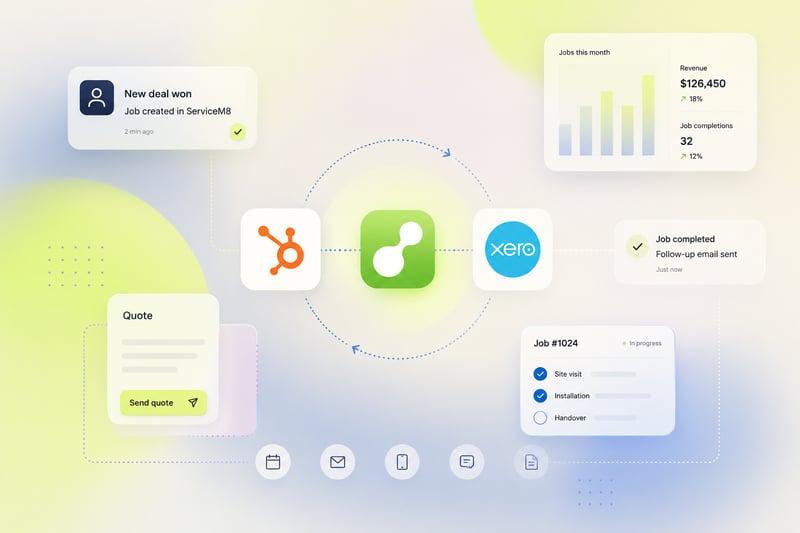
This is the work we do at T&H Digital. We move growing trade, solar and construction businesses off spreadsheets and onto HubSpot, then connect HubSpot to the field tools the business already runs on, so sales and operations finally share one view of every customer. For ServiceM8 users, our Tradiate app keeps HubSpot and ServiceM8 in sync automatically. For Fergus, AroFlo or a custom stack, we build the connection to fit.
Where should you start?
You don't have to solve all of this in one move. A sensible first step is a short conversation about which of the five signs you're seeing and what a CRM would actually change for your business. Often the path is clearer and smaller than it looks from inside the spreadsheet.
FAQ
When should a business move from spreadsheets to a CRM?
When two or more of the common signs appear at once: leads slipping through the cracks, version-control problems across the team, reporting you can't trust, tools that don't talk to each other, or growth stalling for reasons you can't see. One sign is manageable; several together mean the spreadsheet has become a limit on growth.
What can a CRM do that a spreadsheet can't?
A CRM assigns ownership and reminders to every lead, gives the whole team one shared source of truth, captures data in a consistent structure so reporting is reliable, and connects to your other tools so information is entered once. A spreadsheet stores data but doesn't chase follow-ups, prevent version conflicts, or integrate with other systems.
Is HubSpot a good CRM for a small or growing business?
Yes. HubSpot scales from a simple contact database up to a full sales, marketing and service platform, so a growing business can start small and add capability over time. It also connects to field tools like ServiceM8, which matters for trade, solar and construction businesses that run jobs outside the office.
How hard is it to move off spreadsheets onto a CRM?
Less than most people expect if it's planned properly. Existing spreadsheet data can be cleaned and imported, and the setup is configured around how your business actually sells and delivers. The key is setting it up for your real process rather than accepting generic defaults, which is where a specialist partner helps.
Do trade businesses need anything different from a standard CRM setup?
Yes. Trade, solar and construction businesses run jobs in field tools like ServiceM8, Fergus or AroFlo, so the CRM needs to connect to those tools rather than sit beside them. Without that connection, the business ends up with the same split data a spreadsheet caused, just in two systems instead of one.

Comments