

Case Study: Aspen Commercial Interiors

How a Commercial Fit-Out Business Replaced Manual CRM Chaos

With a Live View of Every Project, Builder, and Dollar in the Pipeline
Client
Aspen Commercial Interiors
Year
2025
Services
Custom API Integration
HubSpot Sales Hub Onboarding
Workflow Automation
Onsite Training
Industry
Commercial Fit-Out & Interior Construction
aspen-logo

COMPANY
Aspen Commercial Interiors

INDUSTRY
Commercial Fit-Out & Interior Construction

LOCATIONS
Sydney · Armidale · Melbourne · Brisbane

Challenge
Innergy and HubSpot had no connection. Pipeline values were wrong, change orders were invisible, and a $3.6M gap in reported sales had no explanation

Solution
HubSpot Sales Hub onboarding + full bi-directional Innergy integration + custom builder sub-deal webhook + onsite team training

Time saved
8 hours saved per week tracking down pipeline discrepancies

Real-time dashboards
Real-time dashboard updates, eliminating prep time for weekly sales meetings

automatic sync
100% of opportunities, change orders, and project teams now sync automatically

Services
Custom API Integration · HubSpot Sales Hub Onboarding ·
Workflow Automation · Onsite Training

Tech Stack
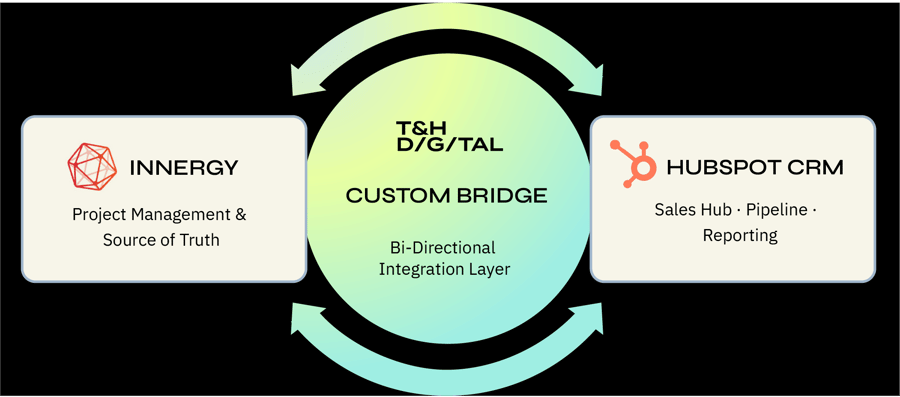
Innergy ↔ T&H Custom Integration ↔ HubSpot CRM

Project Start
March 2025

Onboarding
June 2025
The Challenge: A Problem Hidden in Plain Sight

Aspen Commercial Interiors fits out commercial spaces across five offices and four states. The Heaney family business manages a high-volume pipeline of projects, from initial submission through to completion of verbally confident, builder awarded and converted interiors. Each job has multiple builders involved, and change orders can shift a project’s value by hundreds of thousands of dollars mid stream.

The problem was that none of this complexity was visible in one place.

Two Systems That Did Not Know Each Other Existed

Aspen ran their project management in Innergy, a construction-specific platform that held the source of truth for every opportunity, bid, contract value, change order, and project team member. HubSpot held their CRM: contacts, pipeline stages, deal values, and sales reporting.

The two systems had no connection. Every time a job moved forward in Innergy, someone had to manually replicate that movement in HubSpot. Every time a change order was approved, it existed in Innergy and nowhere else. Every time a new builder was added to a bid, HubSpot did not know.

The Builder Tracking Problem

Aspen's sales process has a layer of complexity that most CRMs are not built for. On any given project, multiple builders compete for the job. Aspen needs to track which builders are bidding, which one was awarded the contract, and which were unsuccessful, all associated to the same underlying opportunity.

HubSpot's standard deal structure has no native way to represent this. The team was managing it manually, with no reliable record of builder win and loss rates, no way to report on which builders they were winning with most often, and no visibility into which deals were sitting at the builder-awarded stage versus verbally confident.

The Gap

The most concrete symptom of this disconnect was a discrepancy in Aspen's reported sales figures. Variation amounts, which are change orders applied in the current year against jobs originally won in prior years, were not being captured in HubSpot's pipeline at all. Sales leadership was making decisions on numbers that were structurally incomplete.

This was not a data entry error. It was an architectural gap: HubSpot had no concept of a change order, and Innergy had no mechanism to push that data across.


The Growth Ceiling

With five offices, four states, and a pipeline spanning submissions, variations, and multi-builder bids, Aspen could not scale on manual reconciliation. The team's time was absorbed by cross-checking systems rather than winning work. The data they were managing their business on was, structurally, wrong.

The problem was not a lack of data.
Both systems held detailed, accurate records.

The problem was that neither system knew what the other one knew. Reconciling them manually was not just slow. It was creating a version of the business that was structurally incomplete.

The Solution:
A Production-Grade Bridge Between Innergy and HubSpot
T&H Digital came on board in March 2025, starting with a complete audit of both systems and a Miro-mapped data flow before a single line of code was written. The engagement covered three interconnected layers: a full HubSpot Sales Hub configuration built for commercial fit-out, a custom Innergy integration built directly against the Innergy API, and an onsite training session with the full Aspen leadership team.

The Architecture

The Architecture
TH-811 - Account Managers Diagram-2
The Architecture
TH-811 - Account Managers Diagram (mobile)-1
HubSpot Sales Hub:
Built for Commercial Fit-Out
HubSpot was configured from scratch around the way Aspen actually works, not around a generic sales pipeline. That meant custom deal stages mapped to Aspen's real process: Submitted, Waiting on Subbie Pricing, Verbal Confident, Builder Awarded, and Closed Won/Lost. Deal tags for contract type cover Lump Sum and Construction Management. Custom fields capture basis of award, type of work (fit-out, new build, asset repositioning), and closed lost reasons.
Revenue spreading was built out with installment fields so individual payment schedules can be tracked per deal, which is essential for a business managing projects that span financial years. A leads pipeline was added alongside the main opportunities pipeline to give the team a clean separation between active pursuits and qualified prospects. Custom state-based reports and a forecasting dashboard were built specifically for the weekly sales meeting.
Innergy Integration:
Built Directly Against the API
The integration was built directly against the Innergy API. No middleware, no Zapier, no third-party connector. T&H Digital's development team reverse-engineered the Innergy data model, mapped every relevant object to its HubSpot equivalent, and built a production-grade sync that runs continuously.
The sync is designed to respect manual changes. When HubSpot is updated by a team member, the integration does not override that change on the next sync cycle. Both systems stay current without stepping on each other.
  • Opportunities created and updated in real time

  • Primary bid value mapped to deal converted amount

  • Change orders linked to original project with variance calculated

  • Companies, contacts, and project team members synced

  • Stage updates reflected without overriding manual changes

  • Opportunities originating in HubSpot created in Innergy

  • No duplicate records across systems

  • Sales team can work in whichever system they prefer

  • Builder sub-deals created automatically via webhook

  • Builder win/loss status tracked at bid level, not just project level

The Builder Sub-Deal Webhook: Custom Logic for a Construction-Specific Problem
Builder tracking required a solution that does not exist in HubSpot out of the box. T&H Digital built a custom webhook that fires whenever a company is associated with a deal in HubSpot. The webhook checks the company's type field, and if the company is tagged as a Builder, it automatically creates a linked sub-deal representing that builder's bid on the project.
As builders are added, sub-deals appear. As bids are won or lost, the status is tracked at the builder level, not just the project level. For the first time, Aspen can run reports on builder win rates, track which construction management firms they are winning with most often, and see exactly where each project sits in the bid process.
Onsite Training:
The Full Heaney Team
In June 2025, T&H Digital ran a full-day onsite HubSpot Sales Training session at Aspen's Sydney CBD office. Eight members of the Aspen team attended, covering pipeline management, deal tracking, calling, dashboard use, and the builder sub-deal workflow. The session was recorded and documented for onboarding future staff.
The Results: What Aspen Can See Now That They Could Not Before
Aspen went live in June 2025. The integration has been running continuously since, with T&H Digital maintaining the connection and handling schema changes as Innergy updates their platform.

The Gap, Closed
For the first time, change orders are tracked in HubSpot and linked to their original projects. The Project Variance field gives sales leadership a real-time view of how much each project has grown or shrunk since the original contract was signed. The dollar figure that sat outside the CRM now shows up where it belongs.

Builder Intelligence, Live
Aspen can now see which builders are active on which projects, what their bid status is, and how their win rate compares across the portfolio. This data did not exist in either system before the integration. Innergy tracks bids but not CRM-level outcomes. HubSpot had no concept of a builder sub-deal. The integration created a capability that neither system had on its own.

Pipeline Values That Reflect Reality
Before the integration, HubSpot deal values were whatever someone last typed in. Now they reflect what Innergy knows: the original contract value, the current contract value, and the variance between them. When a project shifts in scope, HubSpot reflects the change within the next sync cycle without anyone touching the CRM.

The Scalability Foundation

Aspen is a growing business operating across four states with an expanding team. The integration means that new projects, new team members, and new offices do not add manual CRM overhead. They add data. The system scales with the business without anyone doing extra work to keep it current.

Who This Solution Works For

The same integration framework delivers results for any construction or project-based business managing complex bids, change orders, and multi-stakeholder projects across a CRM and a job management platform.

If your CRM and your project management system do not agree on the value of your pipeline, you are not dealing with an admin problem. You are making growth decisions on incomplete information.

Commercial fit-out and interior construction businesses
Project management firms with multi-builder bid processes
Civil and construction businesses using Innergy
Businesses where change orders and variations are a regular part of the job
Sales teams managing 10 or more active projects simultaneously across multiple states
Any business where the CRM and project management system do not agree on pipeline value
Construction businesses making growth decisions on pipeline data they do not fully trust
Businesses expanding into new states without wanting to add CRM admin overhead
Teams spending time each week reconciling two systems that should be talking automatically
Any HubSpot user who needs construction-specific deal logic that the platform does not support natively

Our Credentials

HubSpot Accredited Solutions Partner • ServiceM8 Integration Specialist • Published Integration Developer
HubSpot-Custom-Integration-Accreditation-and-platinum-solutions
How a Custom HubSpot + ServiceM8 Integration Eliminated 10+ Hours of Weekly Admin
Connected HubSpot deals directly to ServiceM8 jobs. When a deal closes, the job is created automatically — no manual re-entry, no missed handovers between sales and field teams.
How a Custom HubSpot + ServiceM8 Integration Eliminated 10+ Hours of Weekly Admin How a Custom HubSpot + ServiceM8 Integration Eliminated 10+ Hours of Weekly Admin How a Custom HubSpot + ServiceM8 Integration Eliminated 10+ Hours of Weekly Admin How a Custom HubSpot + ServiceM8 Integration Eliminated 10+ Hours of Weekly Admin How a Custom HubSpot + ServiceM8 Integration Eliminated 10+ Hours of Weekly Admin How a Custom HubSpot + ServiceM8 Integration Eliminated 10+ Hours of Weekly Admin How a Custom HubSpot + ServiceM8 Integration Eliminated 10+ Hours of Weekly Admin How a Custom HubSpot + ServiceM8 Integration Eliminated 10+ Hours of Weekly Admin
lumberjack-cutting-wood-with-chainsaw copy-1
A Triple Integration Between Pylon, HubSpot & ServiceM8 Saved a Full Day of Admin Every Week
Three platforms connected in a single bidirectional system — solar sales, field operations and CRM working from the same data without any manual handover between teams.
A Triple Integration Between Pylon, HubSpot & ServiceM8 Saved a Full Day of Admin Every Week A Triple Integration Between Pylon, HubSpot & ServiceM8 Saved a Full Day of Admin Every Week A Triple Integration Between Pylon, HubSpot & ServiceM8 Saved a Full Day of Admin Every Week A Triple Integration Between Pylon, HubSpot & ServiceM8 Saved a Full Day of Admin Every Week A Triple Integration Between Pylon, HubSpot & ServiceM8 Saved a Full Day of Admin Every Week A Triple Integration Between Pylon, HubSpot & ServiceM8 Saved a Full Day of Admin Every Week A Triple Integration Between Pylon, HubSpot & ServiceM8 Saved a Full Day of Admin Every Week A Triple Integration Between Pylon, HubSpot & ServiceM8 Saved a Full Day of Admin Every Week
Solar Panel Stock Photo
How We Gave a Premium Retailer One View of Every Sale, Store & Staff Member
A multi-store premium retailer needed a single source of truth across locations, staff and sales. Custom HubSpot + Shopify integration with live sales data, staff performance tracking and inventory visibility in one place.
How We Gave a Premium Retailer One View of Every Sale, Store & Staff Member How We Gave a Premium Retailer One View of Every Sale, Store & Staff Member How We Gave a Premium Retailer One View of Every Sale, Store & Staff Member How We Gave a Premium Retailer One View of Every Sale, Store & Staff Member How We Gave a Premium Retailer One View of Every Sale, Store & Staff Member How We Gave a Premium Retailer One View of Every Sale, Store & Staff Member How We Gave a Premium Retailer One View of Every Sale, Store & Staff Member How We Gave a Premium Retailer One View of Every Sale, Store & Staff Member
Joe Bananas Title

Is Your Pipeline Value a Number You Actually Trust?

If your CRM and your project management system do not agree on what your pipeline is worth, you are making growth decisions on incomplete information. The gap between those two systems is costing you more than time.


Book Your Free 15-Minute Integration Map →